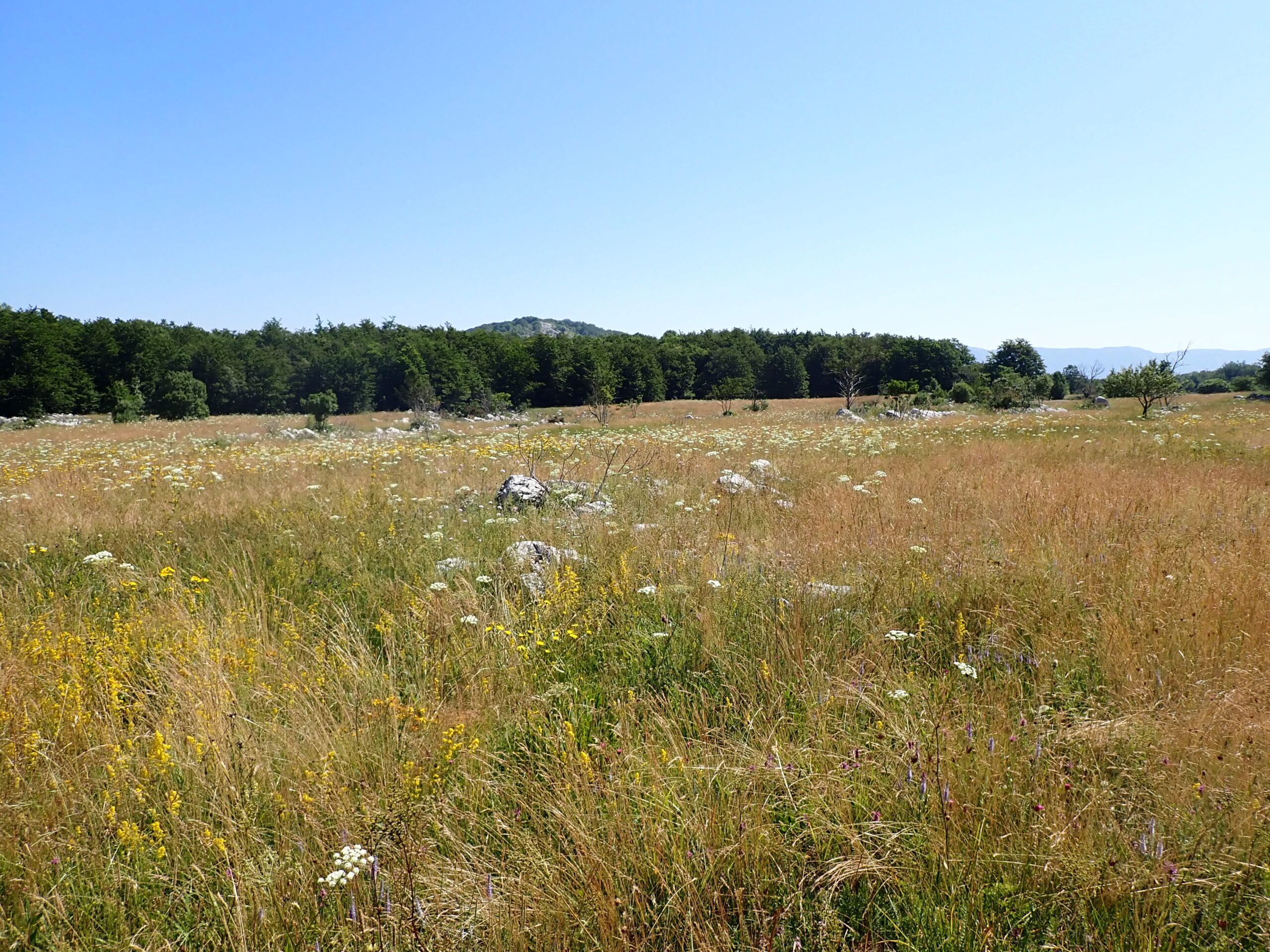
Grasslands are one of the world’s major ecosystems, covering nearly one-third of the Earth's land surface. They are divided into natural, semi-natural, and improved grasslands. Natural grasslands are areas shaped primarily by climatic processes, grazing, or fire, such as steppe grasslands or high-mountain grasslands above the tree line. Semi-natural grasslands are the result of human intervention in nature, most commonly through forest clearance, and require regular grazing or mowing to be maintained; most grasslands in Croatia belong to this type. Improved grasslands are created through ploughing and sowing agricultural cultivars or high-yielding grass species.
Grasslands are home to numerous plant and animal species, many of which are exclusively bound to grassland habitats. Various species of orchids, meadow wildflowers, and butterflies are just some of the organisms that inhabit our grasslands and serve as their unique ornament. Grasslands rank among the most biologically diverse ecosystems, yet they are also one of the most threatened habitat types, experiencing the greatest loss of biodiversity in Croatia. The decline of extensive livestock farming, improper mowing, or the lack of mowing altogether are the main drivers of their disappearance.
Does planting trees on grasslands count as nature conservation? Although reforestation and tree planting are frequently portrayed in the media today as the primary way to protect nature, this is a misconception, as not every area needs to be forested. Let us protect our grasslands and allow grasslands to remain grasslands, and forests to remain forests! Our work includes expanding knowledge about the natural value of Croatia’s grasslands, as well as raising public awareness and educating people on their importance. Many target species of the Natura 2000 ecological network are exclusively bound to grasslands, meaning that by regularly monitoring their population trends, we also indirectly monitor the condition of the grasslands themselves. The Dalmatian ringlet butterfly (Proterebia afra dalmata), which inhabits dry karst rocky grasslands; the marsh fritillary butterfly (Euphydryas aurinia), found on both wet and dry grasslands; and the meadow viper (Vipera ursinii), which inhabits mountain grasslands, are just a few examples of species whose population monitoring helps us track the condition of grassland habitats and contribute to their conservation.